Safety shoe ratings explained: SB, S1, S1P, S2, S3 and SR
The letters on a safety shoe tell you what it has been tested to. Here is a plain-English guide to SB, S1, S1P, S2, S3, S6, S7 and the extra codes like SR, P, PL and PS.

Quick answer
The standard behind the letters
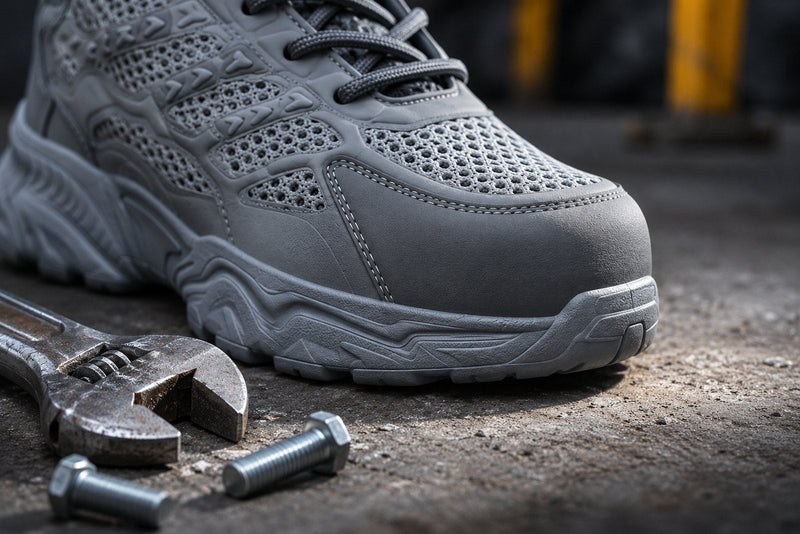
Safety footwear sold in the UK and EU is tested to EN ISO 20345. Every certified safety shoe has a toe cap that protects against a 200 joule impact (roughly a 20 kg weight dropped from about a metre) and 15 kN of compression. The class letters (SB, S1, S2…) and extra codes tell you what else it has been tested for.
200 J toe cap
The minimum for every safety shoe, from SB to S7.
Puncture resistance
A midsole that stops nails and sharp debris (P, PL or PS).
Water resistance
Upper tested against water penetration (S2, S3) or the whole shoe (S6, S7).
Antistatic
Required from S1 upwards.
SB to S7 in one table
| Class | What it includes | Typical use |
|---|---|---|
| SB | 200 J toe cap, basic slip resistance | Basic requirement; often combined with extra codes, e.g. SB P |
| S1 | SB + closed heel, antistatic, heel energy absorption | Dry indoor work: warehouses, workshops |
| S1P / S1PL / S1PS | S1 + puncture-resistant midsole | Indoor work with risk of nails or sharp objects |
| S2 | S1 + water-resistant upper | Indoor/outdoor work, occasional wet |
| S3 / S3L / S3S | S2 + puncture resistance + cleated outsole | Construction, groundwork, outdoor sites |
| S6 | S2 + whole-shoe water resistance (WR) | Wet conditions, no puncture risk |
| S7 / S7L / S7S | S3 + whole-shoe water resistance (WR) | Wet, muddy outdoor sites |
Extra codes: SR, P, PL, PS, WR and more
| Code | Meaning |
|---|---|
| SR | Extra slip resistance: passed a test on ceramic tile with glycerine (very slippery). Basic slip resistance (tile + soap solution) is now part of every class. |
| SRA / SRB / SRC | Slip-resistance marks from the older 2011 version of the standard. You will still see them on shoes certified before the update. |
| P | Puncture-resistant metal midsole |
| PL / PS | Non-metal (textile or composite) midsole, tested with a 4.5 mm nail (PL) or a thinner 3 mm nail (PS) |
| WR | Whole shoe is water resistant |
| WPA | Upper resists water penetration and absorption |
| FO | Outsole resistant to fuel oil (now optional) |
| HRO / CI / HI | Heat-resistant outsole / cold insulation / heat insulation |
| M | Metatarsal protection |
| LG / SC | Ladder grip / scuff cap (new in 2022) |
What changed in 2022
The standard was updated as EN ISO 20345:2022. The main changes buyers notice:
- Slip resistance is now built in. Every safety shoe must pass a basic slip test; the optional, tougher glycerine test is marked SR. The old SRA, SRB and SRC marks are being phased out.
- Puncture resistance is split by type. P means a metal midsole; PL and PS mean a non-metal midsole and which nail it was tested with.
- New waterproof classes S6 and S7 for footwear that keeps water out completely.
- Old certificates stay valid until they expire, so you will see both versions on shelves for a while.
Read the label, not the advert
Which rating for which job
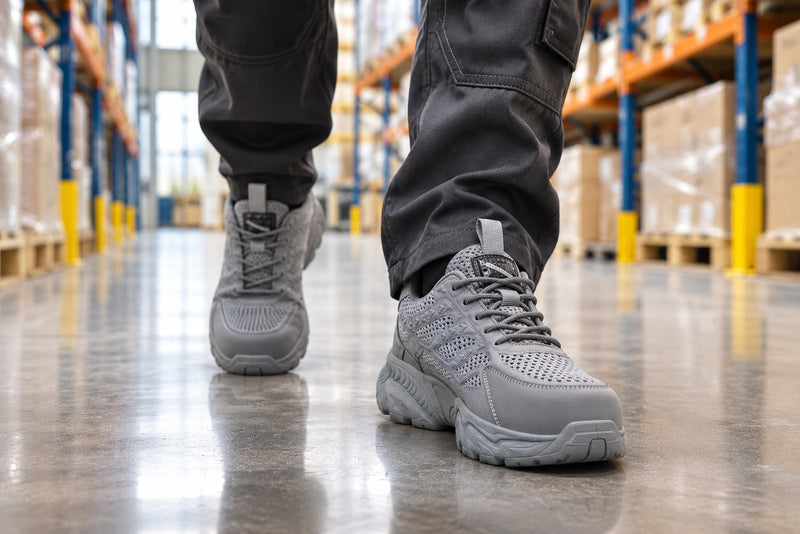
Warehouse, logistics, factory
S1P or SB P with good slip resistance. Lightweight safety shoes are usually the most comfortable choice.
Construction and groundwork
S3 boots are the usual site requirement: puncture-resistant, water-resistant and with a cleated sole.
Kitchens and food production
Look for strong slip resistance (SR, or SRA/SRC on older certificates) and an easy-clean upper.
Delivery and driving
Light S1P or SB P trainers: protection for loading, comfort for the cab.
Your employer’s risk assessment decides the minimum. When in doubt, ask which class is required and which extra codes matter on your site.
Examples from our range


Every ElytStep safety shoe lists its rating on the product page. Our trainer-style safety shoes are rated SB P SRA, SecurX+® is S1P SRA and our S3 safety boots are built for site work.
Frequently asked questions
Is S1P better than S3?
What does SB P mean?
What is the difference between SRA and SRC?
Do I need S3 boots on a UK building site?
Find the right rating for your job
Every product page shows its class, toe cap and midsole. Free UK delivery and 30-day exchanges.